Most outbound lists are built from two filters: industry and company size. That finds companies that could buy, not the ones likely to buy soon. We add buying signals, such as a growing team, new job posts, recent funding or the right location, and use them to decide who gets contacted first.
Below is how we did this for a commercial leasing firm in Singapore, with a sample of the list we showed them (contact names blurred).
Why industry and size aren't enough
A list of "tech companies in Singapore with 11 to 100 staff" runs into thousands of names. Most of them have no reason to talk to you this quarter. If you work that list evenly, your callers and your LinkedIn messages spend most of their time on people who are happy where they are.
Buying signals change the order. They don't tell you who will buy, but they tell you who has a reason to be thinking about it now.
The example: a commercial leasing firm
Our client finds office space for companies and earns its fee from the landlord, so the tenant pays nothing. Many companies don't know that. Their best deals come from companies moving into the prime business districts, where commissions are highest.
So the question for the list was simple: which companies in those districts are likely to need a new office in the next 6 to 24 months?
Step 1: Build the list from where the deals are
The base list comes from three things the client already knew about their best customers:
- Location. Companies whose office is in the prime districts the client wants, from Raffles Place and Marina to Bugis and City Hall.
- Size. 11 to 100 staff to start. Big enough to need a proper office, small enough that the decision sits with a few people.
- Who to contact. At companies of about 20 staff or fewer, the owner, founder or managing director. Above that, the people who run the move: HR, finance and office managers.
The client also told us which sectors to leave out, such as retail outlets, clinics and other property agencies.
Step 2: Rank the list by signals that a move is coming
Then we look for signs that a company is outgrowing its space. Each one is a reason to contact them first.
Signal | Why it matters | Where it comes from |
Team grew 10% or more in the past year | More people in the same space. The office starts to feel small. | Headcount growth from LinkedIn Sales Navigator |
Hiring now | New roles posted in the past two months mean more desks soon. | Recent job posts |
Funded in the past 12 months | New money often pays for a bigger or better office. | Funding data |
In a coworking or serviced office | Companies tend to move out of flexible space once the team settles and grows. | Our own list of 198 coworking and serviced-office centres in the target districts, matched by postcode and floor |
The signals rank the list; they don't decide who is on it. Not every company shows every signal, and a company with none can still be moving. The signals just decide who hears from us first.
How we built the coworking list
The coworking signal shows how this works when no database has the answer. The client told us flexible-office tenants are some of their best prospects. No data provider has a "sits in a coworking space" field, so we built one.
- Start from what the client knew. Their own list of 40 coworking and serviced-office operators.
- Add every centre we could find. We checked operator websites (WeWork, JustCo, The Executive Centre, Regus and others) and used AI to search a company database for coworking, serviced and flexible offices in Singapore. That found about 30 operators the client's list didn't have.
- Keep only the target districts, with floors. Each centre is recorded with its postcode and the floors it occupies, and postcodes are checked against Singapore's official address register.
The result: 198 centres from 77 operators across the prime districts, with 244 postcode-and-floor keys to match against.
Why floors matter: many centres sit in big towers with hundreds of ordinary tenants. A company at the same postcode as a WeWork is only a maybe. A company at the same postcode and on the same floor is very likely a member. Addresses that belong to virtual-office providers work the other way round: they flag companies that don't have a real office to move, so they drop down the list.
What the client saw
Before the project started, we pulled a sample: 25 decision-makers at 13 companies in the target districts, every one of them with a team that had grown at least 10% in the past year. Each row says why the company is on the list.
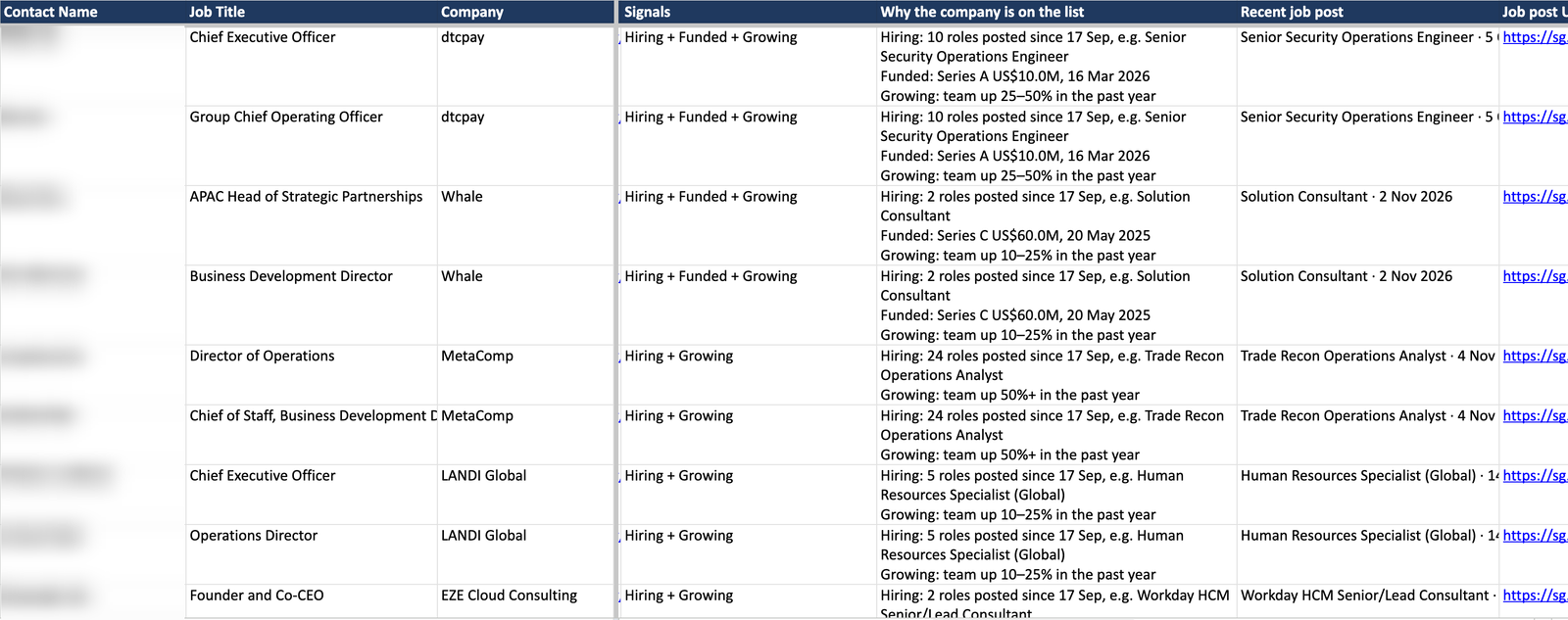
The sample list: why each company is on it. Contact names are blurred.
One company in the sample is a payments firm that raised a Series A in March, has posted 10 roles since mid-September, and has grown its team by 25 to 50% in a year. Another posted 24 roles in the same period after growing by more than half. Those are the companies we contact first.
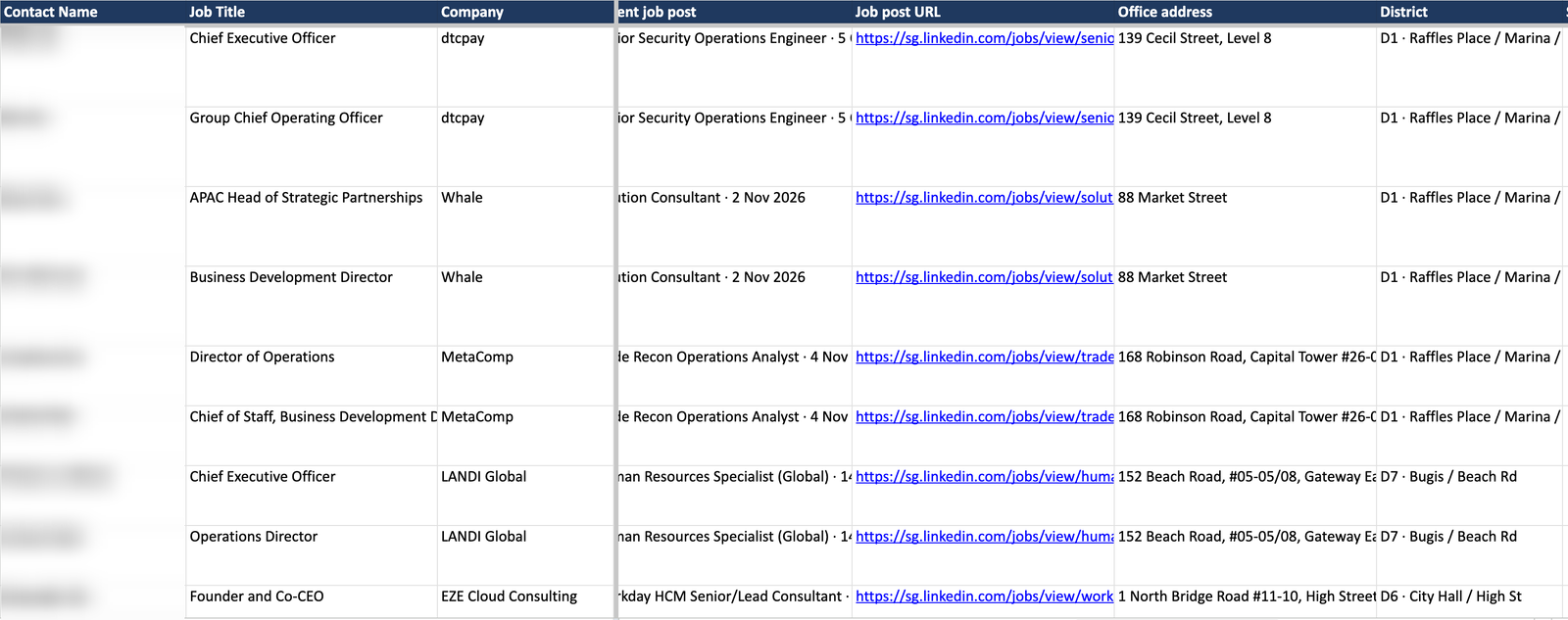
The same list with each company's office address and district.
Where AI helps, and where people decide
AI does | People do |
Checks thousands of companies for growth, hiring and funding signals | The client picks the signals that matter in their market, from what they know about their best deals |
Builds lists no data provider has, like the 198 coworking centres, then matches company addresses to districts and to those centres | We turn that knowledge into filters the data can actually answer |
Writes a one-line reason for each company, and a personalised first LinkedIn message for each person | We check every name, and the client approves the list before anyone is contacted |
The client brings the industry knowledge. They knew prime districts pay more and that coworking tenants move. We don't know that on day one. Our job is to find a way to pull it from the data.
How this works in other markets
The signals change with what you sell. Some we'd look for:
- HR or payroll software: companies hiring their first HR manager, or growing past 50 staff.
- IT and cybersecurity services: companies opening a new office, raising funding, or hiring IT roles they can't fill.
- Event venues: companies with large teams in the area, and HR or marketing staff who plan staff events.
If you can describe what your best customers looked like just before they bought from you, there's usually a signal we can find for it.
Questions buyers ask
What is a buying signal?
Do you only contact companies that show a signal?
Where does the data come from?
Do I see the list before you contact anyone?
Want a sample list for your market?
Tell us who your best customers are. We'll tell you which signals we'd look for, and whether we can find them in the data.
Or reach Nic directly: WhatsApp +65 9179 6725 · email nicholas@funnelcycle.co